

Before you can fix an uneven floor, you need to understand how uneven it really is — and where the problems start. That’s why one of the first tools we bring to any floor leveling job is a rotating laser level or line laser.
Whether you’re leveling joists in a second-story bedroom in Orange County, checking subfloor dips in a Whittier bungalow, or identifying crawl space sag in a Riverside ranch, laser leveling gives you a clear, objective map of the space. No guessing. No “eyeballing.” Just accurate data that guides professional repair.
💡 What Is a Laser Level?
A laser level is a device that projects a perfectly straight, level laser line across the room. It can:
- Help identify floor slope
- Show the highest and lowest points
- Serve as a consistent reference when adding framing, supports, or subfloor
There are several types (manual, self-leveling, rotary), but for most handyman and residential work, a self-leveling cross-line laser or rotary laser on a tripod works best.
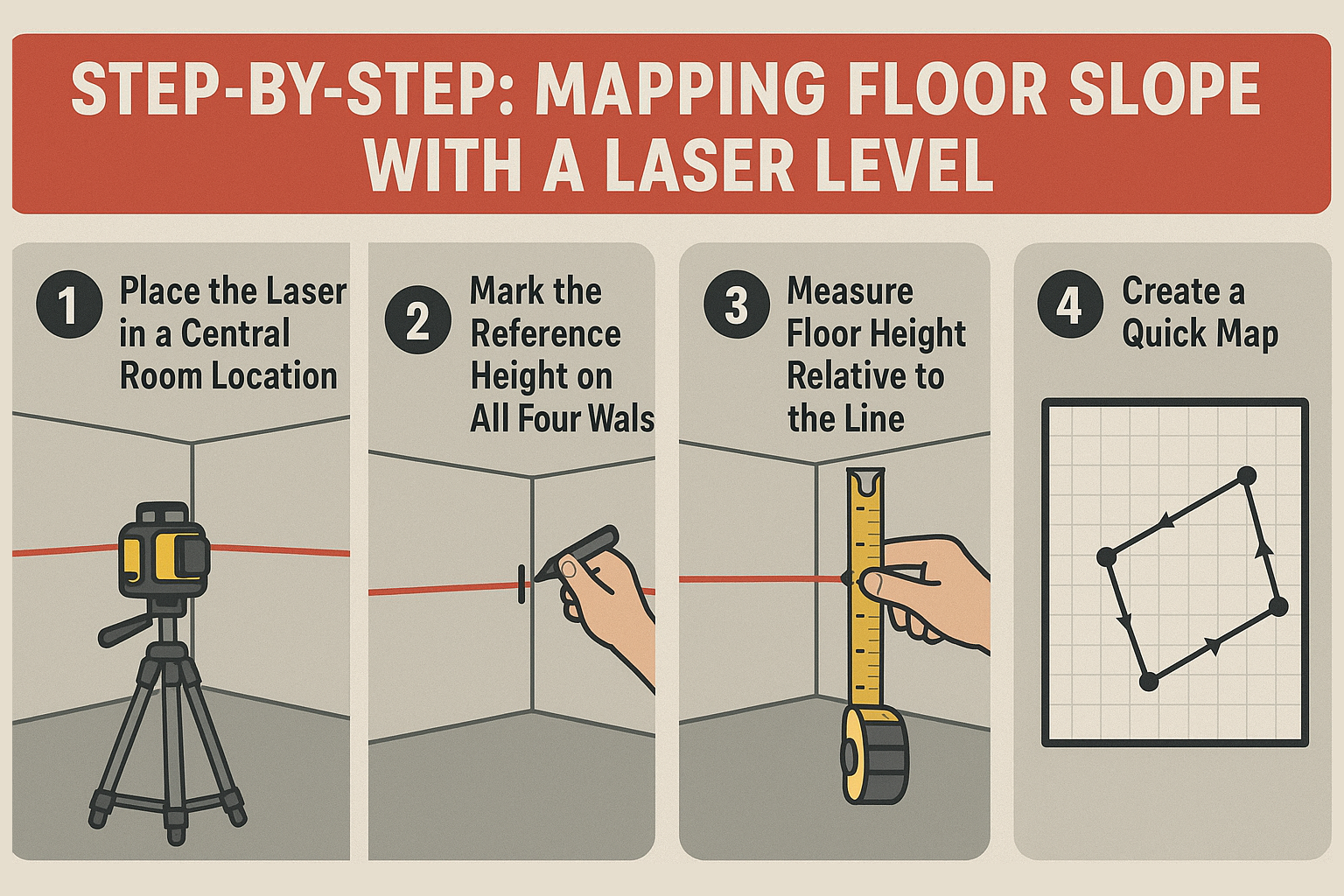
🔧 Step-by-Step: Mapping Floor Slope with a Laser Level
1. Place the Laser in a Central Room Location
Use a tripod to set the laser about waist-high. Make sure it’s level (most tools self-correct).
2. Mark the Reference Height on All Four Walls
Using a measuring tape or laser detector, mark the laser height on each wall — this becomes your baseline.
3. Measure Floor Height Relative to the Line
At various spots (corners, midpoints, doorway transitions), measure from the laser line down to the floor.
- A smaller number means that spot is higher
- A larger number means it’s lower
4. Create a Quick Map
Sketch the room and jot down floor heights — this gives you a visual of how the floor slopes and where dips or peaks are located.
In one La Habra Heights project, we used this method to find a 3/4″ drop from one corner of the master suite to the opposite side. That allowed us to sister joists and level the room precisely — without trial-and-error.
🧰 When This Method Matters
Use laser leveling for:
- Planning floor leveling or joist sistering
- Checking if new subfloor is flat before flooring install
- Diagnosing settlement or sag from below
- Matching floor heights across doorways or remodel zones
📚 Related Articles You’ll Want to Read:
- 👉 0201 – How to Level a Sagging Second Story Floor Without Tearing Everything Apart
- 👉 0204 – Sistering Floor Joists to Reinforce Raised Floors
- 👉 0205 – When to Add Crawl Space Supports Under Raised Foundation Homes
- 👉 0207 – Subfloor Upgrades: Why We Use 1-1/8” Sheathing
🔍 Serving Orange County & Beyond
We use laser levels on nearly every floor leveling job — from Fullerton to Rancho Cucamonga — because guessing leads to mistakes. Whether you’re preparing for new flooring or correcting a decades-old sag, we’ll help you identify the problem precisely and fix it right.
Leave a Reply